 This page is also available in Dutch ›
The DiSSCo consortium in
THE NETHERLANDS
DiSSCo-Netherlands is a consortium of 12 DiSSCo members plus additional partners with representatives from natural history museums, research institutes and the national nodes of two Research Infrastructures, GBIF and LifeWatch. Among the Dutch members is Naturalis Biodiversity Center which is the signatory for the DiSSCO-NL consortium and host of the DiSSCo Coordination and Support Office (CSO). All Dutch consortium members agree that open data and open science is a requirement to develop the DiSSCo Research Infrastructure that allows answering questions that are related to ecology, climate change, food security, public health, bio-economy and taxonomy.
The first steps taken by the DiSSCo-NL consortium is to agree on a common collection description scheme that is implemented in the ‘Nationaal Natuurhistorisch Collectieoverzicht (NNC)’ dashboard (see Dutch Natural History Collection dashboard). The Dutch consortium collectively represents a natural history collection with more than 50 million specimens including collections of international importance notably from Indonesia, the Guianas, tropical Africa and on the Dutch flora, fauna and geology. The dashboard enables the identification of institutional subcollections and can drive Digitisation-on-Demand requests to further digitise the Dutch collection.
The development of DiSSCo can only be successful when developed in collaboration with existing Research Infrastructures like the Global Biodiversity Information Facility (GBIF), Catalogue of Life (CoL), and LifeWatch among others. NLBIF, the Dutch GBIF node, is centered between all these initiatives and it was agreed by the Dutch consortium that NLBIF acts as a national node for DiSSCo-NL.
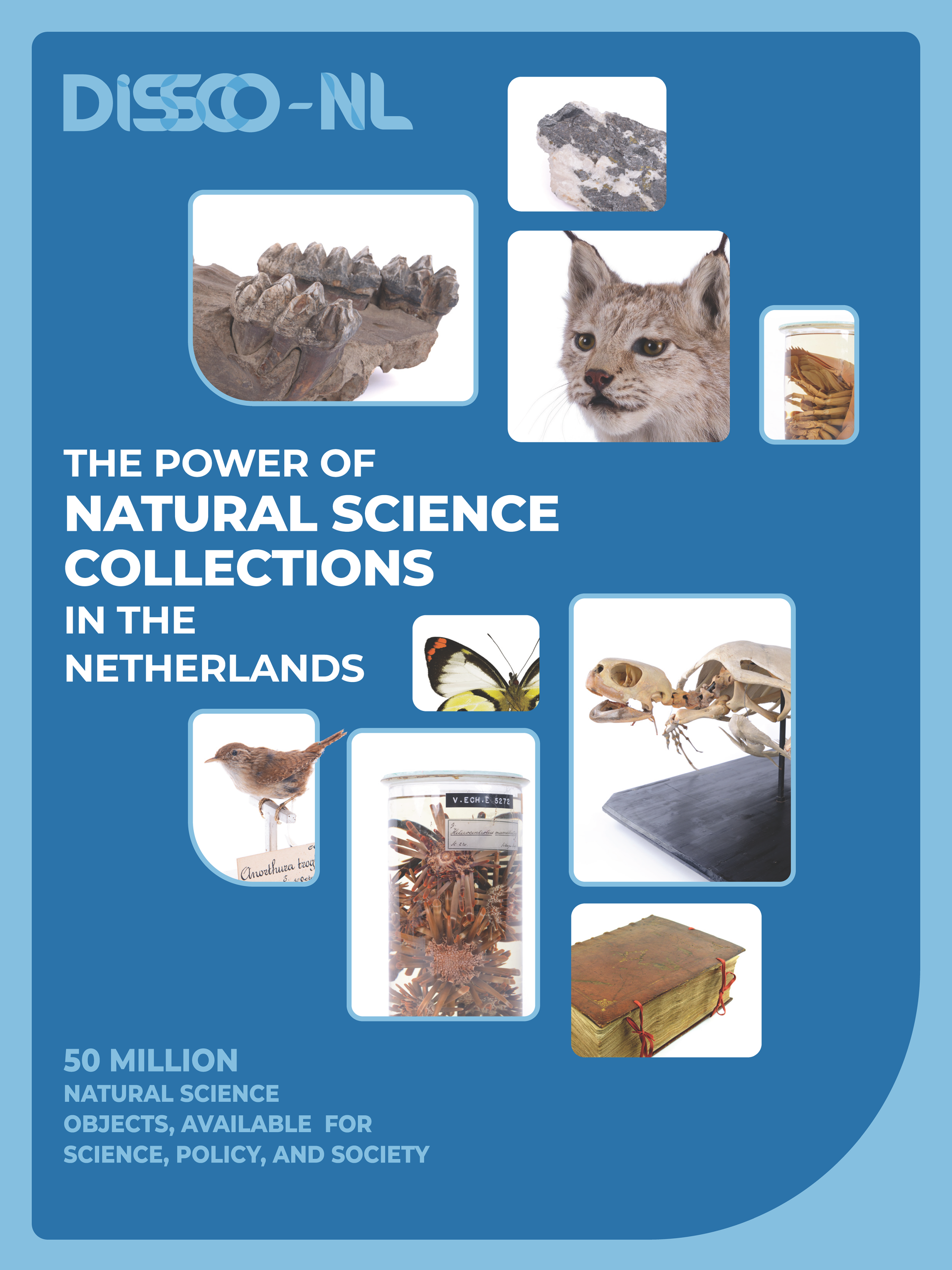
Read DiSSCO-NL’s “The power of Natural History collections in the Netherlands” (2026)

Roadmaps
National Funding
Naturalis Biodiversity Center, University of Amsterdam-Institute for Biodiversity and Ecosystem Dynamics, Westerdijk Fungal Biodiversity Institute – KNAW, University Twente and NLBIF submitted a Dutch roadmap application for large-scale Research Infrastructures titled ‘ARISE – Authoritative and Rapid Identification of Species and Ecosystems’. The proposed infrastructure integrated the following components:
- A Biobank located with the world-class collection facilities of Naturalis and Westerdijk Fungal Biodiversity Institute for storage, preservation and access to reference specimens and DNA.
- A dedicated Sequencing Facility for high-throughput DNA extraction and sequencing of reference specimens and of genetic material requiring identification.
- An expanded version of the Dutch Species Register, linking all Dutch species with validated reference sequences, images, sound recordings and other information.
- A Species Identification Engine combining bioinformatics, machine learning and the reference materials of the Dutch Species Register to process inputs matching any of the supported evidence types and to supply identifications for the species represented.
- A Biocloud, an integration layer t0 collects, link, and enrich all of the identifications and data delivered by the Species Identification Engine.
- Several Demonstration Sites for field capture of specimens to address gaps in the Dutch Species Register and to provide materials and data products to test the Species Identification Engine.
Many of the proposed components of the ARISE infrastructure serve as the Dutch contribution to the development of DiSSCo.
Everything on one screen
Dutch Natural History Collection dashboard
The DiSSCo-NL consortium has made significant progress in the high-level mapping of institutional collection holdings which are visualized in the ‘Nationaal Natuurhistorisch Collectieoverzicht’ dashboard featured below. The dashboard is based on collection size estimations and by no means represents exact numbers. The dashboard will be regularly updated and further enriched with more accurate estimations.